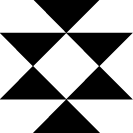
1. Svastika* / Surna / Svarga: A symbol of whirlwind, motion, and elemental forces, originating in the Balkan region. Its meaning depends on orientation: clockwise, counterclockwise, or balanced. The balanced position is the most challenging and most powerful, representing control of natural and cosmic energies; It is associated with the cult of the Slavic god of the sun and the fire of Svarog. The motif have been in Bulgarian embroidery since the Neolithic period. Represents people's best hope for fertility, success, love, joy, and prosperity.
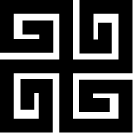
2. Elbetica: "God's home" (from alpha – the almighty, and beta –
home).
It depicts the beginning of the world and serves as a two-dimensional
model of the universe. Its hyphenated cross structure appears not
only in embroidery but also in architecture, ritual objects, and
comparative symbols such as "mandalas" and "shambala" in the
Asian cultures. It represents the four directions in the world, merging
into a common stable center that keeps them in sync. This is how the
idea of the cycle of nature is interpreted – winter, summer, spring and
autumn.
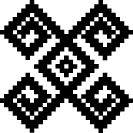
3. Kanatica: A motif resembling a winged creature, most commonly found in carpets rather than needle embroidery. It consists of two interlocking triangles: one male and one female, symbolizing the union of energies and the creation of new life; The pairs of triangles whose vertices touch symbolize the masculine and feminine beginnings. Their "connection" at the vertices represents the creation of a family, and the triangles below and above them are the generation they leave behind. It symbolises the eternal cycle of life.